Every carrier and broker executive has fielded some version of the same question this year, from a board member, a producer, or a client: is AI coming for the broker’s job? Zywave commissioned an in-depth study of the U.S. insurance distribution market to answer with evidence instead of opinion. The Broker of the Future is out now, and it paints a fascinating picture of where AI is truly heading in insurance.
Will AI Replace the Insurance Broker? The Data Says No
The short answer to the question above, as outlined in Part One of the report, is no. The longer answer is that insurance is sold, not bought. Someone still must spot the gap between what a client says they need and what they’re exposed to and close it. AI doesn’t replace that judgment; it just sharpens it.
Buyers aren’t using AI to shop for coverage on their own, either. Zywave’s research analyzed 2,313 job postings from the teams that buy insurance at U.S. companies, plus carrier hiring data. Of the postings that mention AI, nearly all that activity targets a company’s own paperwork, not the broker relationship.
Inside carriers, claims workflows have adopted AI furthest, followed by marketing and fraud detection. Only about 4% of AI-related hiring touches broker-facing tasks. Interestingly, not one carrier in the study named replacing the distribution channel as an objective.
The Bigger Risk Facing Insurance Distribution
The issue that should worry carrier and broker leaders more is the worsening talent shortage. Roughly 400,000 insurance professionals have retired since 2021, and there aren’t enough people coming in behind them to take over their roles.
As these professionals retire, they take with them the kind of experience that only comes from sitting through enough renewals and claims to know what matters. More than half the industry’s workforce still sits in service and back-office work, the tasks AI is best suited to take over. Producer and advisor roles, where judgment pays off, remain a much smaller share of the industry’s hiring.
Four AI-Driven Shifts Set to Unlock $100 Billion in New Value
With these seismic shifts taking place in the market, there is emerging opportunity for brokers and carriers alike. Zywave’s research points to four structural shifts spanning personal lines, commercial lines, and group benefits. Together, they’re projected to generate more than $100 billion in new annual value across the industry over the next five to seven years, including continuous underwriting on live data, software absorbing back-office work, sharper risk selection and fraud detection, and entirely new insurable risks created by AI itself.
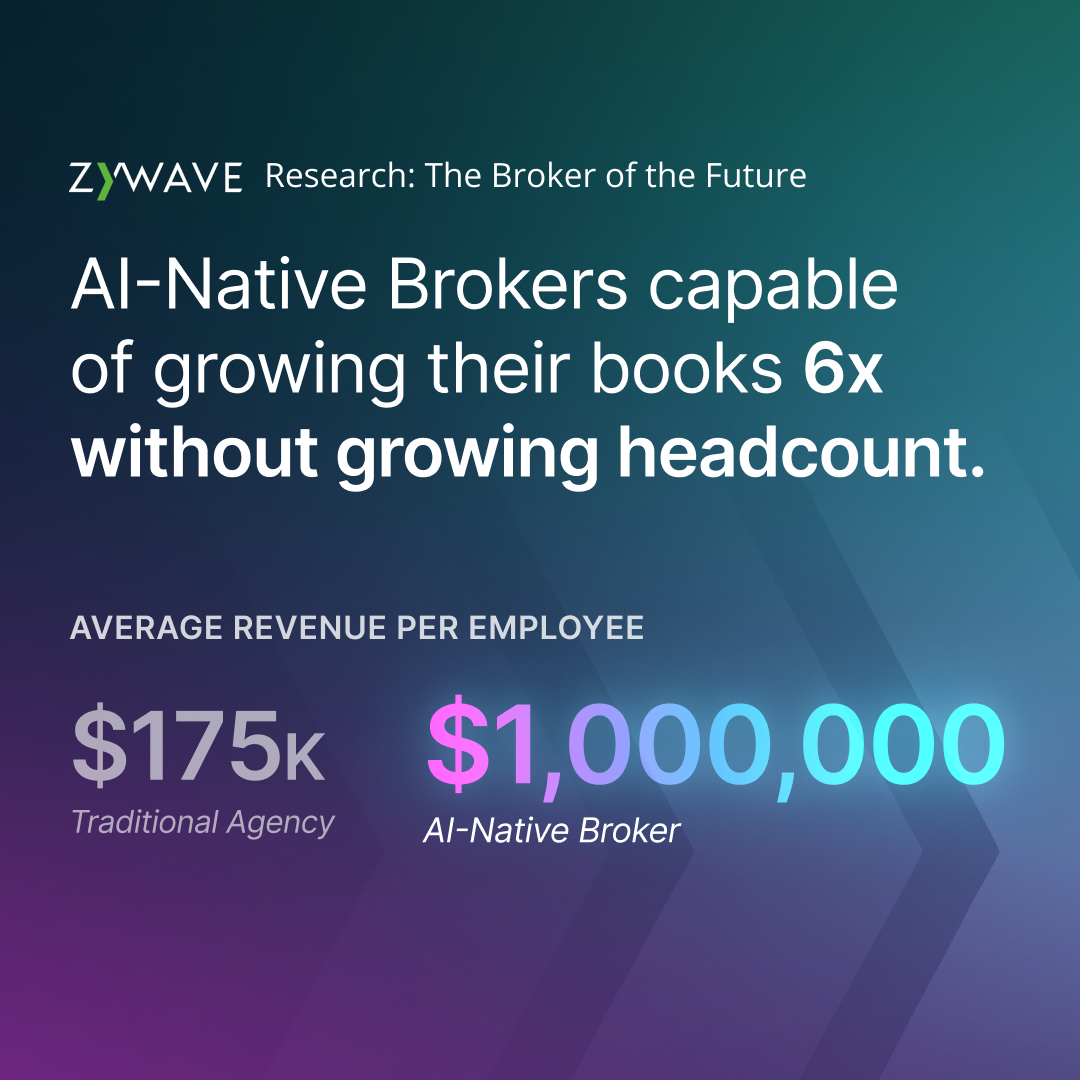
Notably, the study identifies a stark economic gap that is already separating winners from laggards: a traditional insurance agency runs on roughly $175,000 of revenue per employee, while an AI-native broker is proving it is capable of running at closer to $1,000,000, nearly six times as much. In other words, these firms are growing their business faster than they’re growing their headcount, versus reducing staff.
Read Part Two of The Broker of the Future for the Carrier and Broker Playbook
Part One of The Broker of the Future answers whether the broker’s seat survives and where the market’s next $100 billion comes from. Part Two is where it gets practical, offering a playbook for how carriers and brokers capitalize on these shifts, including the foundational data problem every organization needs to solve first and the no-regrets moves leaders can make today, regardless of which path their business is on.
Download Part Two of The Broker of the Future to see how to turn this research into a plan for harnessing AI at your organization.