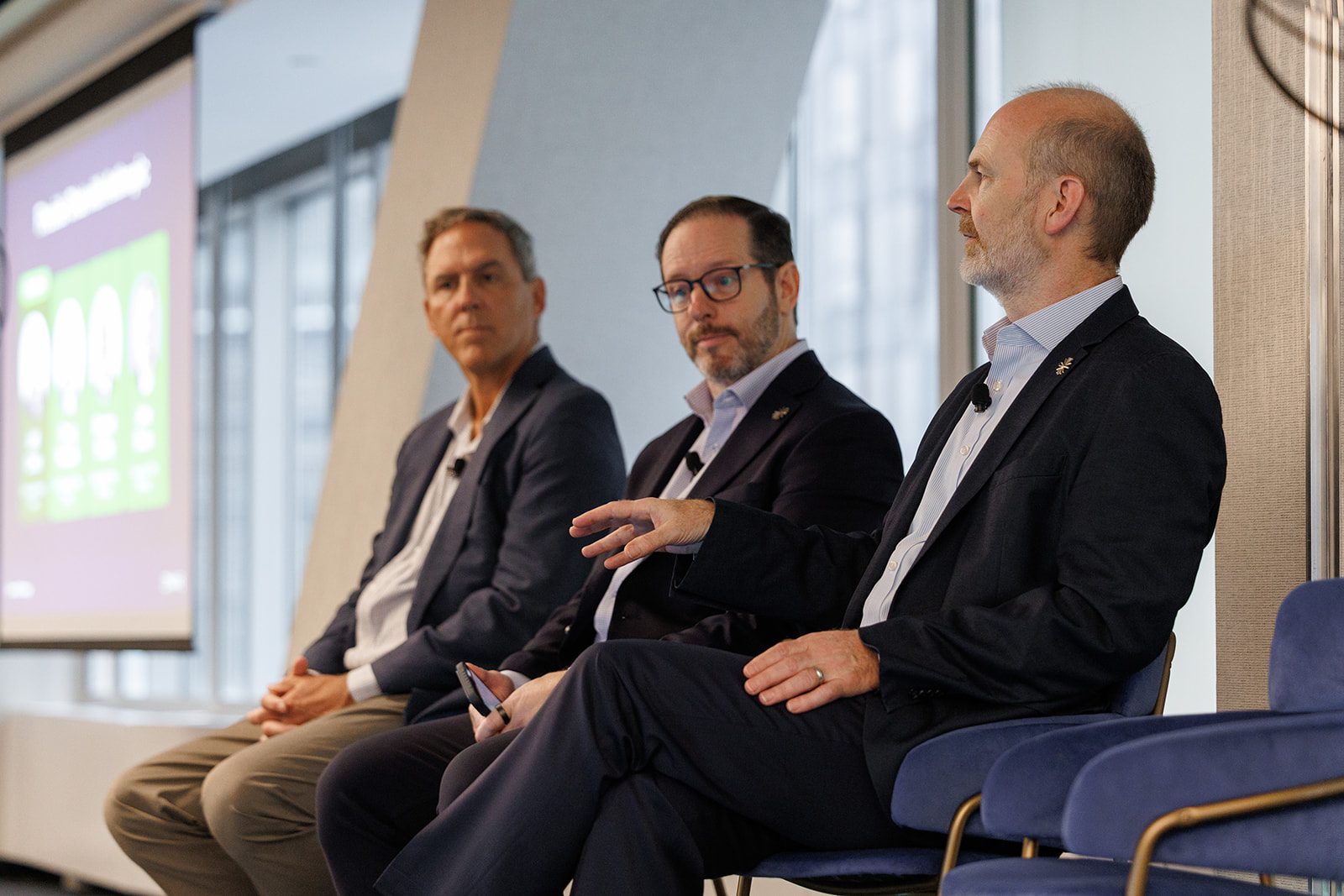
No stadium staging or massive screens, just authentic conversation amongst insurance industry leaders and technologists shaping the next chapter of growth and possibility across the sector. That was the vibe in the room for Zywave’s AI Exchange in New York City, what Jeff Cohen, Zywave Senior Vice President of Industry Relations, introduced as a “pop-up program” highlighted by a panel conversation with Anthropic’s Applied AI Architect Eoghan Scully and Insurance Go-to-Market lead Jake Sloan together with Zywave’s CTO Doug Marquis.
Several core themes came through during the morning session, creating an active dialogue in the room full of carriers, brokers, and MGAs all wondering the same questions: where is AI gaining traction in our industry today, and how should we be planning for what’s next?
What’s Happening Today
Asked for an AI capability that’s genuinely production-ready, Anthropic’s Scully didn’t start with insurance. “The obvious answer is engineering,” he said. “If you don’t have an agentic coding tool, you’re behind.” He pushed the room to study how leading companies use AI in legal, finance, and HR – shared functions across any organization – before assuming insurance’s own use cases are unique.
Specific to insurance workflows, both Anthropic speakers pointed to a number of agentic use cases already in production. Sloan cited submission intake, triage, and clearance as already being modernized, and singled out life insurance: agents at a carrier he’d worked with previously “really struggled to sell life policies,” he said, arguing that cross-sell and upsell — dialing in risk selection with “a level of finite precision” by contextualizing data that’s already sitting inside a carrier’s own systems — is one of the more leading-edge use cases today.
Scully pointed to underwriting support and claims as the two functions furthest along: first notice of loss as an easy on-ramp for teams just getting started, and claims analysis (not claims decisioning) as a way to assemble disparate information without anyone yet trusting a model to decide a claim’s outcome unsupervised. “There’s still nobody that I’m aware of who’s stepped a foot into fully automated underwriting where there’s no human in the loop,” he said.
What’s Already Obsolete
Given the extraordinary pace of AI innovation, the panel was asked what they would have recommended two years ago that’s now obsolete. Scully reached for a concept from philosophy. “Sublation is a term we’ve stolen from the philosopher Hegel.” The concept: something doesn’t become useless so much as it gets absorbed into a more capable layer above it. Two years ago, Scully was convinced retrieval-augmented generation (RAG) was the technology every insurer needed to build. “What happened is RAG got sublated,” he said. “The tools we were building to do that have all been sublated away because the model now is smart enough to do it itself.”
He didn’t stop there. “If you’d asked me that same question even last year, I would have said ontologies are great, we need those. I’m not so sure anymore… I think ontologies are going to be rendered unnecessary within pretty short order.” And on prompt engineering, the skill an entire hiring category briefly formed around: a short, underspecified prompt no longer needs the careful engineering it once did, because “the prompts are in the MCP connectors. The prompts are in the skills.”
What the Future Holds
Pushed on whether this dooms the software that insurers already own, the so-called “SaaS-pocalypse,” Scully predicted a spectrum: some firms will rebuild from scratch with agentic coding tools, others will bolt agentic intelligence onto what they already own, and most will land in the middle, using agentic tools as “the front door” into systems that make up the system of record underneath.
Marquis expanded on the conversation by emphasizing a different part of the story: data. “The data that’s in there is incredibly important,” he said. “At Zywave we build connectors and use AI to bring that data into our systems, because all these agents need that data to operate.” His read on the decision ahead wasn’t necessarily buy versus build at all – the real choice, he argued, is which vendors a firm trusts most with that data layer.
Scully’s closing assignment to those in the room tied it together: go out and read the 1997 Harvard Business Review paper entitled “Strategy Under Uncertainty,” centering on an “adapt” posture for planning when the future can’t be forecast. From Scully’s vantage point, the core idea holds true in today’s AI era, and in practice, that means an MCP connector on everything, documenting processes, and creating organizational artifacts. “It’s not tying you to a particular model, a particular vendor, a particular framework,” he said. “It’s making everything else possible, so you can adapt whatever way the future goes.”
Culture and Governance: Why Technology Isn’t the Bottleneck
The rest of the morning made the case for a different set of considerations: even the greatest technology in the world is only as effective as the culture and governance built to carry it.
Josh Gibbons, Executive Vice President of Sales Enablement and Operations at MarshBerry, shared that according to the firm’s own technology and governance survey, more than 80% of brokers said they use AI — but only 13% said they use it across the organization. What separates the 13% from everyone else, in Gibbons’s telemetry across hundreds of firms, wasn’t size or resources — it was discipline that predated AI entirely. “Organizational discipline is the baseline,” he said, boiling the winners’ traits down to four: data — knowing who owns it and what condition it’s in; case-use discipline — zooming in on three to five priorities instead of chasing thirty; governance, which is less about creating restrictions and more about providing the right bumpers; and change management, which he flagged as the most overlooked and most important of the four. “You can make the best system in the entire world,” he said, “but without the adoption and understanding of folks to use it and encourage to use it, you’re going to be upside down with it.”
On the governance front, Cate Rooney, Head of Commercial Underwriting at Vault, described a specific failure mode in accepting AI outputs: “People are just naturally inclined to over-rely, to think it did it right five times, so the sixth must be right too.” Her advice was to treat AI “like your most junior associate” and to stop accepting “yes, there’s a human in the loop” as a complete answer, asking instead how that oversight is actually monitored.
Chris Keegan, who leads Brown & Brown’s cyber and technology practice, added a governance gap that’s easy to miss: confidentiality leaking through tools nobody centrally approved, whether a client’s policy pasted into a consumer AI assistant or a meeting-note bot capturing voiceprints without full consent. Both agreed the market hasn’t caught up on pricing any of this, as there isn’t yet enough loss data to say definitively what an AI-caused claim looks like.
Closing the morning, Jeffery Arnold, founder of RIGHTSURE, reinforced some of Josh Gibbons’ earlier points by framing AI adoption as fundamentally a change-management challenge rather than a technology one — and put the burden squarely on leadership to define why a rollout exists before asking anyone to use it. His model for the difference between success and failure was blunt: “In a successful company, leadership defines the goal, and employees understand the why…the people and the tech are aligned.” In an unsuccessful one, “the tech is the destination,” giving way to fear of change and, typically, a broken process being simply automated faster instead of fixed.
Arnold rounded out the session with an insightful point: “Technology never creates your culture, it simply reveals it.”
Up Next – Join Us October 29 for Zywave Horizon: Cyber Risk New York
If you missed the thought-provoking conversations at Zywave Horizon: Digital Distribution and Zywave AI Exchange, the dialogue will continue at the upcoming Zywave Horizon: Cyber Risk Conference in New York City on Oct. 29, 2026. This hallmark event for cyber risk professionals and insurance buyers is known for its stellar content, expert speakers, and opportunities to connect. This day of learning and networking draws attendees from throughout the global cyber ecosystem and offers the most up-to-the minute insights on cyber threats, regulatory and legal trends, insurance market conditions, and risk quantification. Register now!