
Zywave Research: The Broker of the Future
AI isn’t replacing brokers. It’s rewriting the economics of the industry, and the winners are already pulling ahead.
Will AI replace the broker? It's the question every carrier and broker executive has been asked in the last year — by a board member, a producer, or a client. Zywave commissioned an in-depth study of the U.S. insurance distribution market to answer it with evidence, not opinion.
The short answer to the existential question is a resounding no. The longer answer is more interesting: the job, the economics, and the technology stack underneath distribution are all changing fast, and the winners will be the carriers and brokers who move first.
The short answer to the existential question is a resounding no. The longer answer is more interesting: the job, the economics, and the technology stack underneath distribution are all changing fast, and the winners will be the carriers and brokers who move first.
The Bold Question
Does the Broker Seat Survive?
Insurance is sold, not bought. It asks people to make a high-consequence decision about something they'd rather not think about at all, which is why the durable skill in this industry has never been paperwork. It's uncovering the hidden context between what a client says they need and what they're actually exposed to. AI amplifies that judgment. It does not replace it. That holds whether the seat in question sells personal auto, a mid-market commercial account, or a self-funded benefits plan. The products differ, but the forces reshaping all three are the same.
AI can already read a submission and compare quotes across carriers. That part is real, and it's happening today. But it stops at the bind, and the reason isn't capability. It's liability. No insurer has emerged to underwrite an AI system's mistake at scale, which is exactly why a licensed human stays in the seat.
AI can already read a submission and compare quotes across carriers. That part is real, and it's happening today. But it stops at the bind, and the reason isn't capability. It's liability. No insurer has emerged to underwrite an AI system's mistake at scale, which is exactly why a licensed human stays in the seat.
Not one carrier in our study named replacing the distribution channel as an AI objective, and the market has been pricing that intent for five years running.
Get the Full breakdown
The Bigger Risk
The Shortage That Should Worry You More
The replacement question isn't the risk that should keep carrier and broker leaders up at night. The Bureau of Labor Statistics projects that by the end of this year, roughly 400,000 insurance professionals will have retired since 2021, and there are nowhere near enough people coming in to fill them.
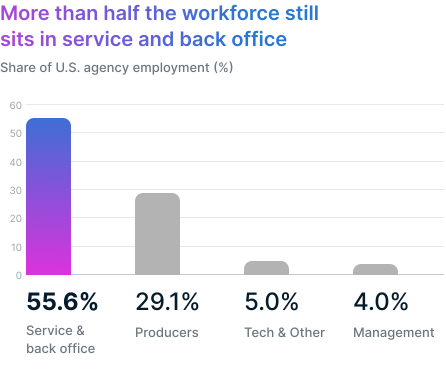
The shortage is really a headcount problem, but the more acute half of it is judgment, the learned experience it takes to do risk-management advisory work well. Meanwhile, more than half of the industry's workforce is still sitting in service and back-office work: the queue of gathering, re-keying, and routine servicing that AI is best positioned to absorb, freeing experienced people to spend more of their time on the one thing that pool of talent should never be spending it on: paperwork.
The shortage is really a headcount problem, but the more acute half of it is judgment, the learned experience it takes to do risk-management advisory work well. Meanwhile, more than half of the industry's workforce is still sitting in service and back-office work: the queue of gathering, re-keying, and routine servicing that AI is best positioned to absorb, freeing experienced people to spend more of their time on the one thing that pool of talent should never be spending it on: paperwork.
Get the Full breakdown
THE MARKET OPPORTUNITY
Four Transformations Unlocking $100 Billion in New Value
The upside doesn't come from replacing people. It comes from four structural shifts in how risk gets priced, serviced, selected, and covered. Our research suggests that, together, these shifts will be worth more than $100 billion in new value across the industry over the next five to seven years:
Carriers price on live data ($10–20B/year) — continuous underwriting against real-time inputs, not a once-a-year snapshot.
Software takes over the back office ($30–40B/year) — the clerical core of distribution work shrinks as AI absorbs it.
Better risk selection and fraud detection ($20–30B/year) — carriers already pay up to 15x more for a well-selected book.
New AI risks become new, insurable coverage ($15–20B/year) — a brand-new specialty line following cyber's growth curve.
Get the Full breakdown
The NEW MODEL
How Distribution Itself Changes
Capturing that value takes more than a product change at the carrier or a point solution at the agency, it takes a different operating model for distribution itself. Our research breaks that down into what happens to the client advisory model, and what we're calling “continuous everything.”
On the economic side, pay increasingly ties to outcomes rather than volume, and fees shift toward advice rather than transaction processing. The advantage goes to whoever's data and incentives already point at book quality, not just book volume.
On the operating side, the data a broker already holds becomes the moat. Every submission, every declination, every certificate of insurance, benefits program summary, declaration page, and loss run is proprietary context a competitor can't replicate from a cold start. Agentic AI moves onto the workflow itself, so monitoring runs continuously instead of on a renewal calendar, while the licensed human still sits exactly where liability requires: at the bind.
Underwriting authority — the pen — keeps moving closer to retail. Delegated authority premium grew from $70.9 billion to $108.7 billion in just three years.
That shift shows up in three problems that resolve once monitoring runs continuously instead of once a year — in personal lines, commercial, and benefits alike:
Get the Full breakdown
WHO WINS
Three Archetypes
This $100 billion opportunity will reward some firms more than others. Three broad trajectories are already visible in our research, and each archetype calls for a different playbook.
1
Scale keeps getting bigger
National and super-regional brokerages keep consolidating premium and talent, buying the capability gap rather than building it.
2
The middle digitizes or gets bought
Mid-sized agencies that don't modernize are the most exposed cohort, and the natural acquisition target.
3
Specialists pull away
Without scale, depth is the way to compete: a defensible niche, carrier access, or command of a specific risk class.
These three paths aren't mutually exclusive inside a single organization — a large national brokerage can and often does run specialist practice groups alongside its generalist book, and a well-run mid-market firm can carve out a defensible niche before it has to choose between digitizing or being acquired.
However, what's not available to anyone is a fourth path: standing still.
However, what's not available to anyone is a fourth path: standing still.
Get the Full breakdown
TAKE ACTION
You Know What's Changing. Now Here's What To Do About It.
Part One of our study makes the case for why the broker seat survives and where the next $100 billion in value comes from. Part Two is the playbook: the operating model, the transformation framework, and the specific moves that get a carrier or broker there, starting with the single economic number that makes the stakes impossible to ignore.
Inside the full playbook:
- The bionic brokerage — what a continuous, always-on operating model looks like day to day.
- The People, Process, and Technology framework — including the data foundation every transformation depends on and usually skips.
- Three no-regrets decisions — the moves that pay off regardless of which path your organization is on.
6x
the revenue per employee an AI-native broker can generate, vs. a traditional agency
3
no-regrets decisions that pay off no matter which path your organization is on
1
data foundation problem every transformation plan has to fix first
Get the PlayBOOK
Get the Report
Download Part Two: The Playbook
The Broker of the Future: The Playbook is the second half of Zywave's research, a practical guide to closing the gap between a traditional agency and an AI-native one. Fill out the form to get your copy.